
The first roundtable panel discussion of day two of the 2026 CDAI Conference on Security and Defence was unique in that all environmental commanders were together in one spot. Moderator, ex-CDS Gen. (ret’d) Tom Lawson, even went so far as to comment that when he was CDS it was almost impossible to get them in one room together at the same time. The panelists were the Commander of the Royal Canadian Navy (CRCN), Vice-Admiral Angus Topshee, Commander of the Royal Canadian Air Force (CRCAF), LGen. Jamie Speiser-Blanchet, and Commander of the Canadian Army (CCA), LGen. Michael Wright.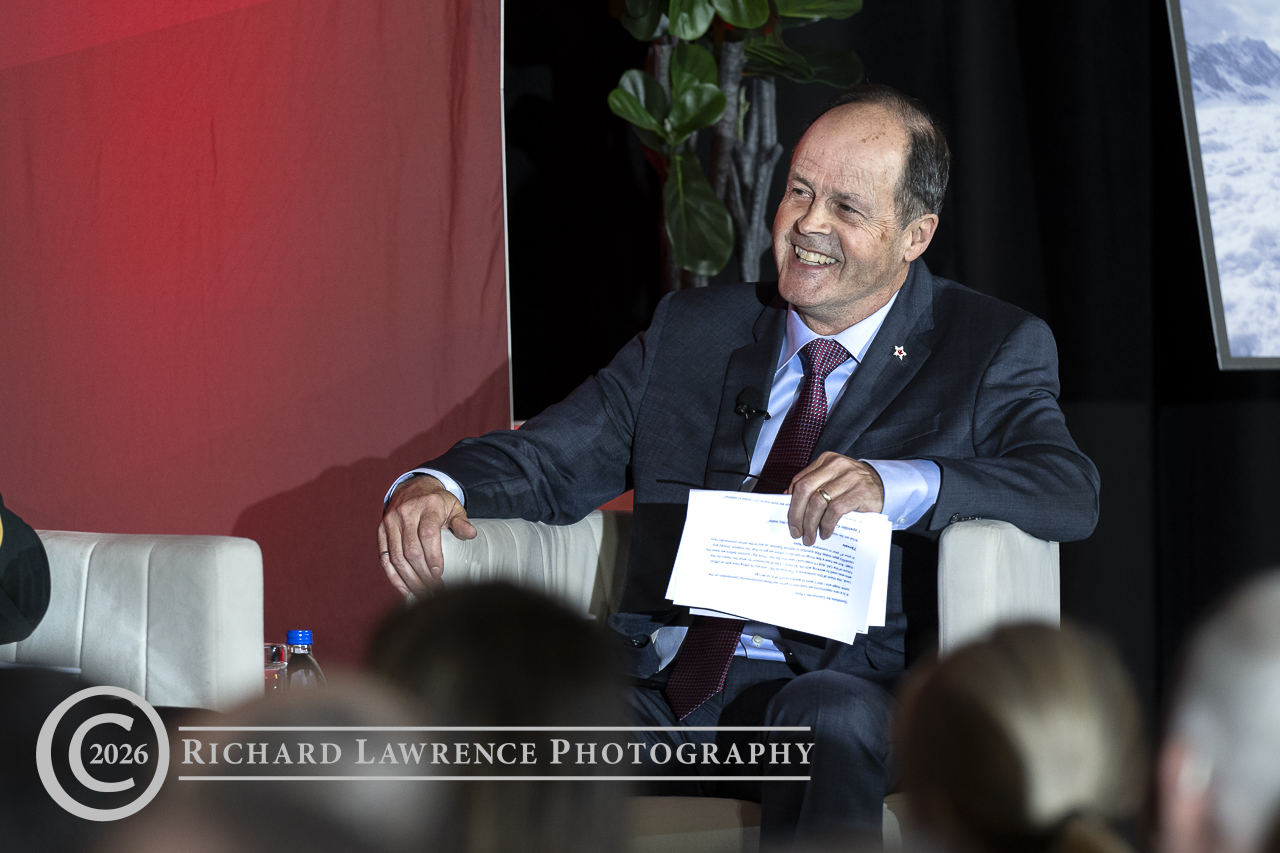
As the conference theme was “on the road to 5%” Tom Lawson first noted that he, when CDS, was working with a budget just slightly above one percent of GDP and that the current commanders are living with the results of that. Shortages of people, poor infrastructure, fleets that are old and having maintenance issues are all a result of underspending on national defence.
But the first question put forward by Tom Lawson was, “[what is] your idea of what the real threats to Canada are and why they matter?”, which was directed to VAdm. Topshee.
VAdm. Topshee quickly noted that Canada is surrounded by three oceans that used to protect us simply because they separated us from threats. This is no longer the case. He said that the oceans “only protect us if we have a navy that is capable of actually enforcing control over those waters” which requires the ability to detect things in the water and then the ability to assess and deal with the threat.
He explained that the traditional threat comes from enemies within missile release range of the North American coast so by hunting enemy submarines and preventing them from getting close enough to do harm can prevent that. However, now threats are more varied, including hybrid threats, drones, things launched off container ships, attacks on sub-sea infrastructure (cutting data cables), and a myriad of other threats. So, VAdm. Topshee sees knowing everything that is happening in Canada’s waters as the first priority.
He also mentioned that Bill C-21 would give the Coast Guard a surveillance mandate which would bring key maritime assets into the picture and they are already seeing benefits from this cooperation. VAdm. Topshee feels that he “has the right equipment and sailors in the right equipment to respond in the most appropriate manner to whatever might manifest in our waters.”
Editor Note: I would argue that this assessment is overly optimistic as I would be surprised if we had one submarine capable of sailing at any one time, our surface combatants are old, replenishments ships not yet delivered, shortage of sailors, helicopters that are old and have maintenance issues, etc. all point to an environment that is in trouble. Yes, recruits are coming in now and there is money for moving forward, but I would judge our current capability to defend the oceans much lower than does “Kraken”.
LGen. Wright noted that the evolution of warfare includes uncrewed technologies, such as those used in Ukraine, along with artificial intelligence (AI) augmenting those systems. Ukraine shows the “…importance of mass, the importance or firepower, the importance of sustainment, camouflage, deception, concealment, things that we used to be quite good at and that we need to get back at regaining the muscle memory.”
LGen. Speiser-Blanchet agreed that the same applies to air and space in dealing with well advanced technologies such as hypersonic missiles or long-range aviation and other threats capable of holding North America at risk already. There’s a lot of development in the space domain, whether from intentional efforts or orbital debris, that Canada must prepare for. The ability to know what the threats are, detect them, and act is what we are striving for.
She continued, pointing out that the current procurement system becomes an obstacle to achieving this as the CAF buckets things, makes standalone projects of one platform or single capability at a time when proliferated threats require a broader understanding of the entire modern ecosystem. Even though the CAF is in the early stages, every ongoing modernization project is contributing “… to that ecosystem that can detect first, decide first, and act first”.
When asked about doing things differently, she explained that things need to be done differently by linking large projects together as they move forward. No longer can projects be service-centric but all environments MUST be included in the planning/requirements phases. She mentioned that the Joint Office for Integrated Air and Missile Defence is a good example as it already has army members as part of the team and is expecting to welcome naval members as well. She said that “… we’re not doing this alone, because we can’t afford to. We don’t have the time, and it’s going to be much more effective and operationally relevant if we continue to work together.”
LGen. Wright chimed in adding that the army has officers embedded with the next tactical aviation capability set (helicopters) because the Army and CANSOFCOM are the two principal users of the helicopter platform. The army currently has 50 major capital projects underway and looking at them as an integrated program rather than individual, unconnected, projects, “… will allow the army to play a greater role in defending Canada at home, but also contributing to the deterrence of threats to Canada by operating at home or anywhere around the world in a more agile and scalable manner.”
Tom Lawson then brought up the new Canadian Joint Forces Command (CJFC) under LGen. Molstad which will take over responsibilities for resources shared across all five domains while leaving domain specific duties with their respective commanders.
VAdm. Topshee stated that one person cannot control everything as the span of responsibility is too great and things would have to be delegated at some point in the organization. So, for functions like medical support, integrated logistics support, clerks, HR, financial admin or non-environmental specific jobs, being contained under a single umbrella so they are common across the entire CAF, at least for the strategic and high-operational levels, will help enable putting a fleet at sea, the army in the field, or the air force on the wing. “It’s a very logical division of responsibility.”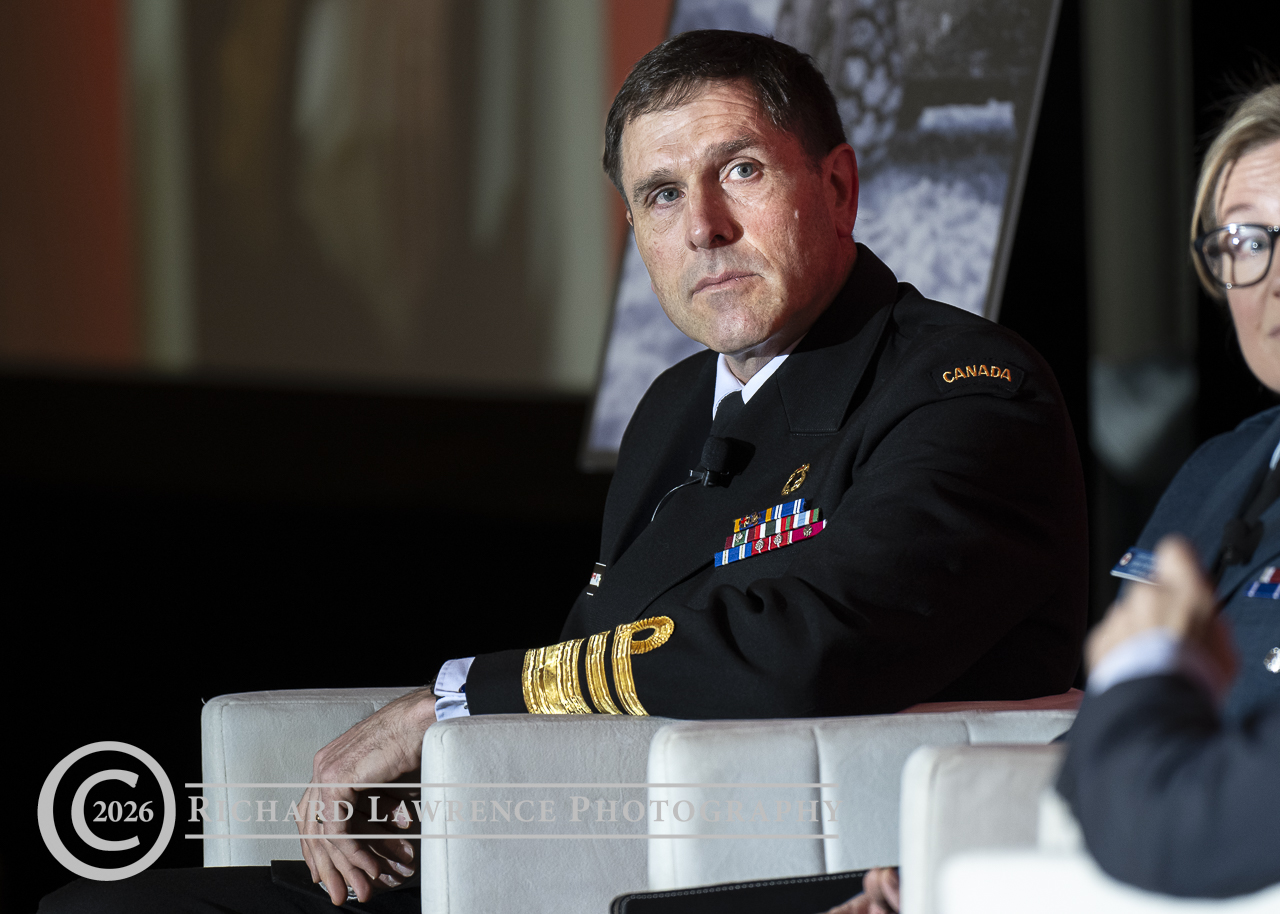
The Navy then has to decide what it needs within its task groups. How to generate sailors, hard sea trades (those that go to sea), and capabilities, in conjunction with Chief of Military Personnel (CMP). All domains then need to build the specialists to handle those functions at the tactical/operational levels as, for example, the army logistics are different from the navy’s and air force’s logistics. Again, strategic levels are handled centrally with the tactical/operational augmented by specialist training.
LGen. Speiser-Blancet added that, although space forces currently reside in the RCAF, she can see where that could change to CJFC as it has multi-domain applications. She also added security forces could come under CJFC as all bases require security, not just keeping people off the bases, but the incoming advanced technologies, fifth generation technologies, and weapons all come with very high security requirements.
Another joint forces capability could be counter uncrewed systems which is very important and timely, especially given lessons learned from the Ukraine conflict. Right now everybody is doing something different and it makes sense to create a CAF strategy for this capability rather than an individual environmental strategy. LGen. Wright added that the army already has counter-UAS deployed in Latvia on Op Reassurance under CJOC and the army will continue to look at specific requirements it might need in conjunction with CJFC.
VAdm. Topshee was asked why he has stayed on so long, now being almost four years as CRCN. He answered that he had some things he personally wanted to fix before he “… could turn over the watch to the next commander of the RCN”, starting with the personnel problems, which was in a death spiral downward. Next, he wanted to make sure the River-class destroyers were in full production, which is now into a full year of construction. The last item was to have the submarine project well on the path to fruition which is now down to two suppliers with qualified bids being assessed.
Going back to personnel, he stated that the Navy is in a good place now with training and total strength growing. The Naval Experience Program (NEP) has turned out to be very successful and is now a source of a third of naval recruits, retaining 80% of those completing the program with about 55% in hard sea trades. They graduate as general sailors without specific occupations but many choose to go further as marine technicians, which the Navy needs the most. The RCN has doubled the production of naval warfare officers, on track to triple this year, and a capacity to train 400 naval technicians per year. The RCN is now running its own Basic Naval Qualification course which will accept 720 recruits this year, 1,000 next year, and 2,000 the year after that, with all who graduate trained to an employable functional point. A fully employable general duties sailor allows a lot of leeway for employment, such as security at Canada’s bases or performing any general sailor duties at sea.
This is a change in training models that can serve across the CAF. Train a recruit to a general common standard, which makes him employable anywhere doing general duties and then provide specialized training afterwards. LGen. Wright echoed this sentiment about rethinking how soldiers are brought into the Canadian Army by getting more soldiers trained to be immediately employable for basic functions within the unit and deployment inside Canada. Employment outside Canada would require a greater level of training.
Tom Lawson then turned the discussion towards the current CAF, being short of people and equipment, and their workload around the world with NATO, NORAD, the Arctic, the Indo-Pacific, etc., as well as domestic operations and modernization. He wanted to know about “overstretching” Canada’s resources.
LGen. Wright was first to the post answering that the Army was, currently, very focused on domestic and the Euro-Atlantic domains. He started by mentioning that Operation Nanook is going from four to seven serials per year with regular forces, reserve forces, and Canadian Rangers all working together with one of the largest Army deployments to the Arctic since 2012 on right now. From the domestic perspective, the CAF is a persistent presence in the Artic, along with the Canadian Coast Guard, and fielding Canadian Rangers in over 200 communities across the country.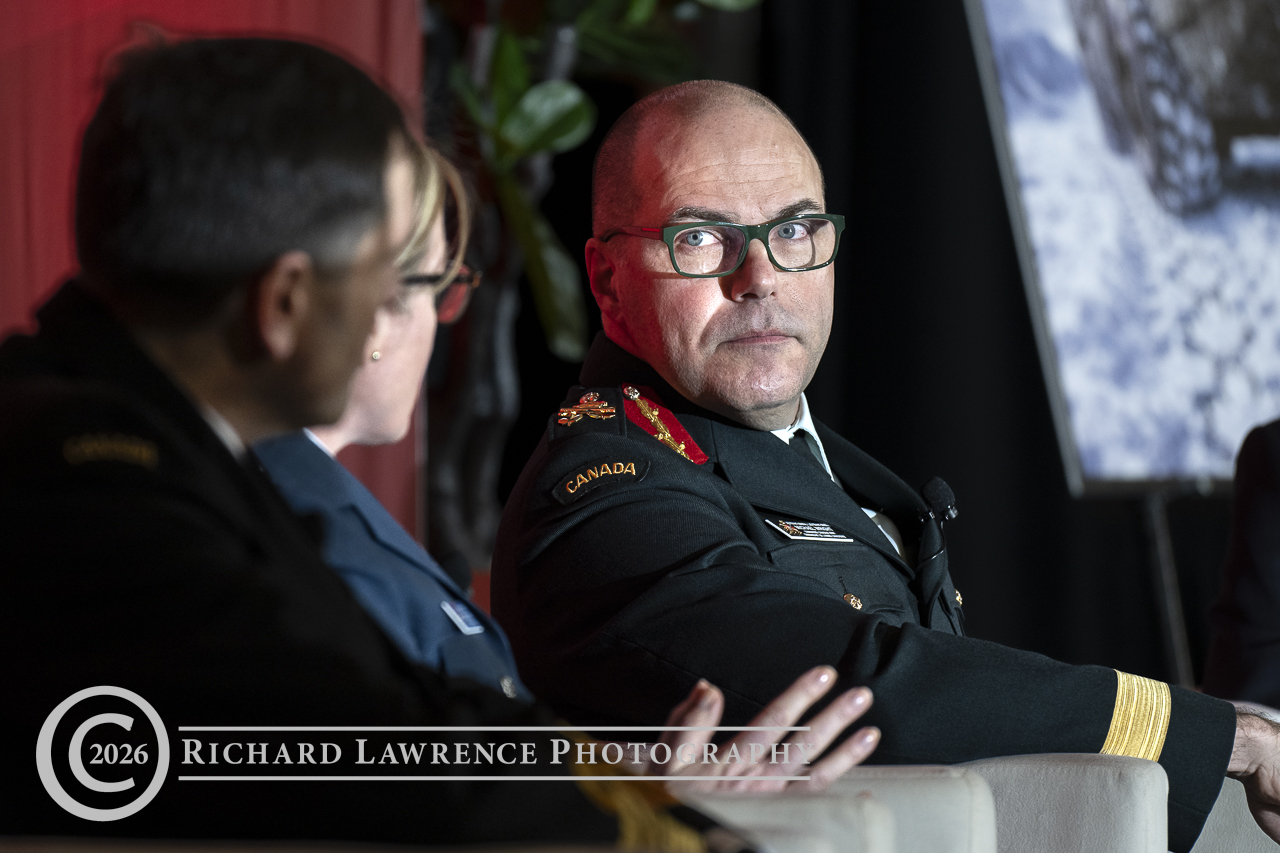
On the expeditionary side, Europe/NATO retains the Army’s focus with 2,000 soldiers as part of a multi-national battle group in Latvia as part of NATO’s eastern flank deterrence. The Indo-Pacific is not much on the Army’s radar but CANSOFCOM and the RCN do have a presence in that region. That being said, the Army is sending soldiers from 2nd Battalion PPCLI to the Republic of Korea to carry out some joint training and to mark the 75th Anniversary of the Battle of Kapyong.
LGen. Speiser-Blanchet voiced that the air force similarly has a split weight of effort with a first priority on continental defense, meaning Canada’s sovereignty and an Arctic presence, which is manifested everyday through NORAD. She does not see these priorities changing with modernization but noted that the growth of the air force and the need for more personnel needs to be addressed.
There also needs focus put on the air fleet modernizations when older air fleets get drawn down as the newer air fleets takes over. Again, there will be a need for training, personnel, and new capabilities and resources must be focused where needed as the RCAF has over 70 projects on the go, spending $230 billion over the next 20 years, before the move to 3.5% and 5% increases are even considered.
VAdm. Topshee made additional comment on the Indo-Pacific as mentioned by LGen. Wright earlier in that the government’s Indo-Pacific Strategy (22 Nov, 2025) directed the Navy to have a near-persistent presence in that area. To that end HMCS Charlottetown and HMCS Asterix are there now. Lesser NAVY resources are being put towards NATO as a frigate can join NATO navy assets quite quickly so the preferred approach is to only go over for major exercises and readiness events to build partnerships with key allies. While Canada occasionally commands things in NATO, the Navy’s main focus is the Indo-Pacific as it’s a maritime theatre.
LGen. Speiser-Blanchet added that some of the operations which are “economies of effort” still achieve a lot of the collective aims. For example, when the RCAF exerts sovereignty with presence over the continent and the Arctic, Canada is “contributing to that deterrence for NATO in terms of the Northern Front and the ability to work collaboratively and inter-operably with our allies.” It strengthens Canadian sovereignty but also Canada’s reliability, credibility, and Canada’s value as a credible ally. The same can be said of the Army’s northern exercises and the Navy/Coast Guard operations in the north.
Tom Lawson moved on with a question regarding some of the newer large capital purchases upcoming. He wanted to know if “… there’s a benefit when you’re purchasing a large weapons system or fleet in dividing that up between providers?” This, of course, could apply to surface combatants, air fleets, and submarines.
VAdm. Topshee took the floor stating that Canada operates mixed fleets all the time with more than one class of surface ship at both Navy bases which are geographically separated. Just divide them as equally as possible. Submarines, however, will be more efficient as a single provider asset.
LGen.Speiser-Blanchet agreed as the RCAF operates mixed fleets in a number of areas. Not every aircraft can be used in every role so mixed fleets are inevitable. Canada also runs into mixed air fleets as newer aircraft replace older aircraft as one doesn’t just replace an entire fleet at once. New aircraft are delivered in dribs and drabs while the older aircraft continue with Canada’s missions. At some point, the weight of new aircraft exceeds the older aircraft and, while the missions remain the same, the older aircraft start to be retired. This is done over time, sometimes years. This is ongoing now with the CF-18 being replaced by the F-35 (until further notice), the CC-130 tanker to the CC-330, and the CP-140 Orion to the P-8. Other fleets are also being changed out in Search and Rescue, Basic Flying Training, Fighter Lead In Trainer, tac hel, etc.
Tom Lawson next voiced interest in the use of autonomous and uncrewed (unmanned) systems, with or without AI, and how that fits into the modernization of the Army.
The Army, said LGen. Wright, is not treating these technologies as projects by rather as an initiative: the Minerva Initiative (The MINERVA Initiative is the Canadian Army’s blueprint for a practical, soldier-focused approach to integrating drones and autonomous systems into Canada’s Army operations [from Canadian Army Modernization website]). As the Army Commander, he has soldiers in every unit who are starving to get their hands on uncrewed technology, largely because they see how it’s being used in Ukraine and other conflicts. They’re already experimenting with it. It’s now important for Canada’s soldiers to identify what type of uncrewed technology is a fit for the Army and connect Canadian industry and engineers to make that happen. Capabilities required include UAS airborne surveillance, command and control of localized battlespace, and munitions deployment.
On the ground, there are many autonomous vehicles that can be used for resupply, medical evacuation, and even ground support, all the time keeping soldiers more out of harm’s way. But it must be kept in mind that there is not a single solution for any of this as a drone that would work for the Ranger in Nunavut might be unsuitable for other areas.
VAdm. Topshsee added that what is happening in the Black Sea/Ukraine makes it appear that surface ships are obsolete and he admires what the Ukrainians have been able to do in their littorals. However, using the example of the success of the USS Carney against all threats in the Red Sea using today’s technology showed that “… a well-trained, well-equipped force of surface combatants can do that.” The future will be surface combatants augmented with drones that the ship controls around that, enabled by AI.
This is the concept of a hybrid fleet, explained VAdm. Topshsee. “In the future, surface ships will be paired with a host of things that are in the air, on the water, and under the water that will enable everything it does and defend it from those threats as well.” But if someone comes up with a better idea then “… we just steal the idea and rebrand it as our own at every opportunity ….”
LGen. Wright agreed whole heartedly with the future being the pairing of crewed/uncrewed assets. Right now, the Army is working with the RCAF on helicopters to see what the Army will have for direct fire capabilities in the air, both crewed and uncrewed. Then the Army needs to decide the direct fire capabilities on the ground, whether crewed, partially crewed, or uncrewed.
LGen. Speiser-Blanchet added that the RCAF is fairly clear that the future will be crewed/uncrewed working together. But, procurement is only part of the problem as the technologies are moving so quickly that it’s difficult to develop the future while fighting with the equipment that we have. Working with autonomous platforms for ISR in the Arctic shows a lot of potential but it must be part of an ecosystem that all works together, not just platforms. The real requirement is to move as quickly as possible, “work with what we have, accelerate where we can, and try to think forward” and hopefully not overstretch.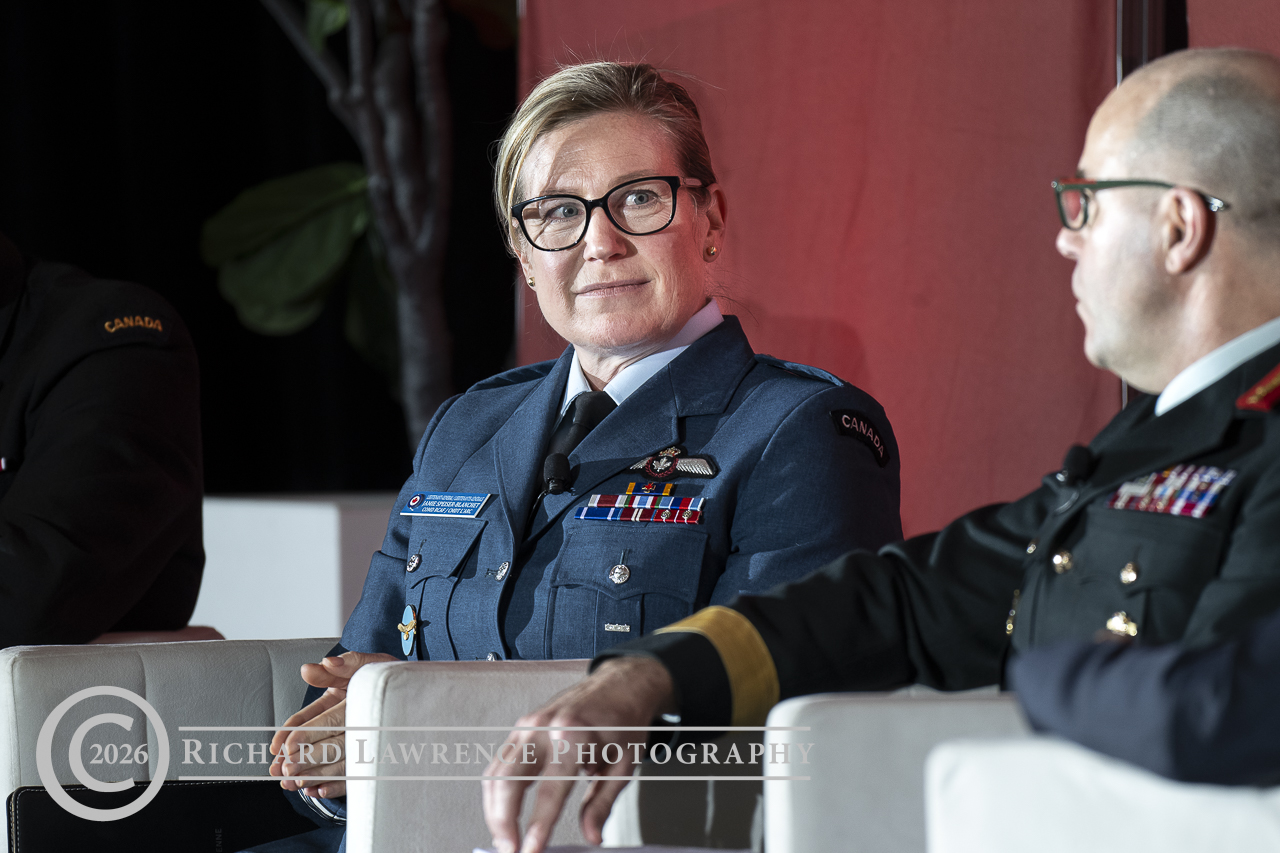
Carrying forward on the point of modernization, Tom Lawson asked LGen. Wright, “What’s modernization other than just the systems and bringing in the latest technology?”
Without hesitation LGen. Wright answered, “It’s about the people, it’s about the capabilities … about ensuring that we have the structure for those people and those capabilities to be able to defend Canada and still conduct missions … around the world.” As mentioned earlier, rethinking how soldiers are brought into the Army by training to a basic employable point initially, with further specialist training afterwards, will help get new soldiers into their units faster and make them useful sooner.
Changing the divisional structure may help as well as currently Canada has four divisions that are based on regions and divisions that are asymmetric because of past decades of divestment, not design. Moving to divisions which are actually designed for task and purpose, moving from four regional divisions to one division centered on the defence of Canada ,will help the Army to be ready for domestic operations, such as the G7, Op Nanook, Op Lentus, and provide the Army’s contribution to the integrated air and missile defence of Canada. It will also provide the footprint for mobilization across the country as Canada is now having a national conversation around mobilization of reserve units which are in 120 communities throughout Canada.
The Army’s maneuver division, which will be known as 1 Division later this year, “… will be taking current regular force brigades from across the country, bringing in some new capabilities, and continuing to force generate for CJOC operations but building the war fighting prowess for major combat operations as a division.” Not a small task since the last time Canada exercised a division was in 1992 and fought as a division was World War II. The Army also really needs to focus on a support division to provide institutional support across the county.
LGen. Speiser-Blanchet agreed that people are key to everything as the technical level of transformation requires digital foundations that the CAF currently does not have but are working towards. “We simply don’t know all of the future occupations that we need so we actually have setup a future occupations working group that is looking[into that]”. The RCAF is trying to create a Space Operator type trade, security forces, mission intelligence planners, and others that have not yet been conceived, all being done in conjunction with Chief Military Personnel. With the new P-8, they need Air Refueling Operators which currently doesn’t fit into existing trades.
VAdm. Topshee added that “… how you train and employ someone is fundamental to whether or not you can retrain them.” Using the new River-class as an example, VAdm. Topshee stated that it will be delivered with the most advanced air-defence system in the world in the maritime environment which will operate in a very dramatic, different way. The expectation was to merge five operator trades into one common operator (naval combat information, naval communicator, naval electronic sensor, and sonar). What happened instead is that those five trades have exploded into 11 different trades.
Where this might work well is if the RCN designs all those occupations and aligns them to what’s being delivered in Canada’s post-secondary education institutes. The delivery of naval training can then be accelerated by leveraging knowledge already acquired rather than re-teaching it.
In order to simplify things a little, VAdm. Topshee suggested bringing in new people as sailors, specifically reservists, fully employable and trained to Common Specialty Qualifications (CSQs) which are common across all occupations that every sailor needs to have. The Navy will identify personal strengths and weaknesses, aptitudes, assess, and then align the new sailor to an occupation. The new sailor still has some choice in the matter but the sailor may want to choose a certain career path, which specific training may not begin for months. Should they have been assessed or have an aptitude for something else as well, and the training starts earlier, that would be presented to them as an option to help get their careers started earlier and fill Navy positions faster.
Meanwhile, the new sailor is still functionally employable and the Navy can leverage that sailor occupation as much as possible while layering on Unique Specialty Qualifications (USQs). USQs would not be tied to specific ranks/occupation, but would be core functions on ships and anyone with those USQs could sail at sea and contribute in a manner that makes the most sense to them. This system would make a lot of sense for reservists who have to balance time between civilian and military life and can’t just move through the system at the same pace for regular force sailors.
Although this is a total re-imagining of the personnel structure, it aligns more with the interests of people today. General Simoneau, Chief of Military Personnel, has turned out to be a great ally to this, watching closely and adjusting what isn’t working as well as expected.
Tom Lawson commented that, although the commanders are at the start of all this build up, in all likelihood they will not be around to see the end-point. He asked, “What could this look like for your successors two and three iterations down the road?”
LGen. Wright had already commented on the large divisional restructure but Canada needs “to enhance our fighting forces in the intermediate term to get greater lethality at range in the five to seven year term and to be persistent at scale over the course of 10 to 15 years”. It could be faster if projects can be accelerated but the emerging ecosystem must be kept in mind. The Army has a plan that is able to be accelerated when new/more resources are made available.
Personnel are also a big concern over the next 10 years both in capabilities and building the strength to 10,000 regular force soldiers. On the reserve side, the Army needs to get the existing 24,000 army reservists up to standards and then look at building the primary reserve up to 100,000. That infrastructure needs to be built and decisions as to appropriate taskings for tactical, operational, and strategic level reserve functions domestically and around the world.
LGen. Speiser-Blanchet stated that the RCAF has a strategy that is setting the groundwork for the RCAF of the future and that is her priority. She needs to set the conditions for that transformation as the RCAF of the future will not look like it does today as it needs to work within the framework of fifth/sixth generation ecosystem. The RCAF needs to know it “… can detect threats, decide effectively with fused and advanced data heavy environments and act decisively with the lethality what we need.” That will make the CAF a valuable ally and allow for credible deterrence while protecting Canadians and Canadian sovereignty.
VAdm. Topshee then mentioned that the RCN and the National Shipbuilding Strategy has delivered the best shipyard in North America in the Irving yard. The non-combatant Harry DeWolf class has allowed Canada to relearn how to build ships and two are being built for the Coast Guard now. They are building the most advanced destroyer in the world and will deliver nine of them by 2040. The two Joint Support Ships are being built by Seaspan who have delivered five of eight ships despite ongoing manpower issues. Both Davey and Seaspan build ships of such quality that Canada has sold the designs for the icebreakers made in both yards to the U.S. Coast Guard. This certainly moves us forward into sovereign capabilities in shipbuilding.
Time for this panel had run out so Tom Lawson thanked everyone for their time and answers before presenting them to the audience once again.


